
Home / Blog / Adaptive learning
Adaptive learning
The Importance of Adaptive Learning in an Online Learning Setup
Online learning removed the one signal teachers relied on most — the look on a room's face. Adaptive learning is how you get that signal back, and it has to run on every attempt rather than every term.
A teacher standing in front of thirty students reads the room without thinking about it. Someone re-reads the same line twice. Someone else has stopped writing. Three people at the back look up at exactly the moment the explanation turns abstract. None of that is written down anywhere, and all of it changes what the teacher says next.
Move the same lesson online and that channel closes. What is left is a grid of muted tiles, a submission count, and a score at the end of the unit — which arrives too late to be worth anything. Adaptive learning is the attempt to rebuild that missing signal out of the only material an online setup actually produces: individual attempts, in order, with timestamps.
What "adaptive" actually means#
The word has been stretched to cover almost anything with a branching path in it, so it is worth being precise. A system is adaptive when it maintains a per-skill estimate of what each learner knows, updates that estimate after every attempt, and uses the updated estimate to choose what comes next.
Three things follow from that definition, and each one rules out a lot of software that markets itself as adaptive:
- The unit is a skill, not a course. "Struggling in Algebra" is not actionable. "Has not held onto the distributive property across four sessions" is.
- The update happens on every attempt. A system that re-evaluates after each chapter test is remedial, not adaptive — it can only react once the term is already lost.
- Being wrong is information, not a penalty. A wrong answer on a hard item early in a topic tells you more than a right answer on an easy one.
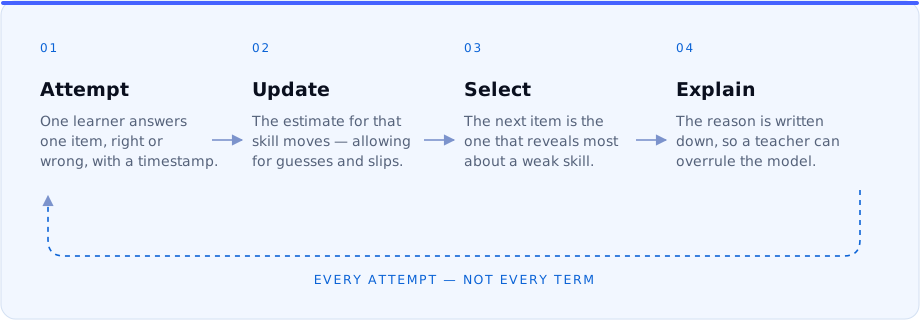
The fourth stage is the one that gets dropped, and it is the one teachers care about. A model that quietly reorders a worksheet is a black box. A model that says "served this because two attempts on the prerequisite failed on Tuesday" is a colleague.
Why the online setup raises the stakes#
In a physical room, a mediocre pacing decision is caught and corrected within minutes, because the teacher can see it land badly. Online, the same decision goes uncorrected for a week.
| What the teacher needs | In the room | Online, without adaptation | Online, with adaptation |
|---|---|---|---|
| Who is lost, right now | Read off faces | Not visible | Per-skill estimate, live |
| Why they are lost | Ask | Guess from a score | Traced to a prerequisite |
| Whether reteaching worked | Ask again | Next unit test | Next attempt |
| Which students to group | Memory | Alphabetical | Same weak skill |
The table is the whole argument. Every row that reads "not visible" or "guess" is a decision a teacher is being asked to make blind, and online learning turns almost every row into one of those.
The research this rests on#
Adaptive learning is not a new idea dressed up in machine learning. Three findings underpin it, and all three predate the current wave of edtech:
- Bloom's two-sigma problem (1984). Students tutored one-to-one with mastery-based feedback performed about two standard deviations above conventionally taught peers. Bloom framed this as a challenge: find group methods that get close. Adaptive sequencing is one attempt at an answer.
- The spacing effect. Practice distributed over time beats the same practice massed into one session — a result replicated for over a century and confirmed in large meta-analyses. A scheduler that knows when a skill was last seen can act on it.
- Retrieval practice. Being asked to produce an answer strengthens memory more than re-reading the material does. This is why an adaptive system asks rather than re-explains by default.
The point of adaptation is not that a computer decides. It is that a teacher finally has something specific to decide about.Working note, TeachScript design review
Bayesian knowledge tracing, briefly#
The model most adaptive systems use is a variant of Bayesian knowledge tracing (Corbett & Anderson, 1995). It holds four numbers per skill: the chance the learner already knew it, the chance they learn it from this attempt, the chance they guess a correct answer, and the chance they slip on one they know.
That last pair is why the mastery curve dips. A confident learner who slips does not get thrown back to the beginning — the model expects a certain rate of slips, and only moves the estimate meaningfully when the evidence is inconsistent with mastery.
What you have to record for any of it to work#
Adaptive learning is downstream of your event log. If the log is thin, no model rescues it. The minimum useful shape of a single attempt looks like this:
{
  "learner_id": "s-10482",
  "skill_id": "alg.distributive-property",
  "item_id": "q-7741",
  "correct": false,
  "response_ms": 41300,
  "attempt_index": 2,
  "hints_used": 1,
  "submitted_at": "2026-08-22T09:14:07+08:00",
  "session": "async-homework"
}
Four fields do most of the work:
skill_id— without it you have a score, not a diagnosis.correctplusattempt_index— a right answer on the fourth try is a different event from a right answer on the first.response_ms— forty seconds on a one-step question is a flag even when the answer is right.submitted_at— spacing needs real timestamps, and asynchronous online work spreads attempts across days.
What adaptive learning will not do#
Being straight about this is what keeps a pilot from failing on false expectations.
It also will not fix a curriculum whose prerequisites are wrong, and it will not replace a teacher's judgment about a specific student — which is exactly why the "explain" stage matters. Every decision the model makes should be overrulable, and the override should be one click.
Does adaptive learning mean every student gets a different lesson?
No — and the version where it does tends to fail. Whole-class teaching stays; what adapts is the practice around it. Students still get the same lesson on Tuesday, then practice that is weighted toward the skills each one has not held onto. Teachers keep a common reference point, and the class does not silently fragment into thirty untrackable paths.
How much data before it is useful?
Roughly a few attempts per skill per learner before an estimate stops being noise. In practice that means one topic with a decent item bank produces usable signal within two to three weeks of normal homework — not a full term.
Where to start#
- Pick one topic with a clear prerequisite chain
- Tag its items to skills, not to chapters
- Log every attempt, including the wrong ones and the abandoned ones
- Run it for one term and compare against the same topic last year
- Ask the teachers whether the explanations were usable — that is the real test
If you want to see the loop running against a real class rather than a demo dataset, that is the conversation we like having.
- adaptive learning
- online learning
- knowledge tracing
- assessment